

Stand Rooted in Justice
He has shown you, O mortal, what is good.
And what does the Lord require of you?
To act justly and to love mercy and to walk humbly with your God. Micah 6:8
If the ice storm at the beginning of this year taught us anything, it taught us that storms can change what we see without destroying what lies beneath.
Heavy ice weighed down the trees. Branches bent beneath the pressure. Limbs broke and fell. Trees that once appeared strong were left wounded and bare. Yet beneath the frozen ground, something remained: the roots.
The roots were still holding. Still nourishing. Still anchored beneath the soil. Still preparing the trees to bud, bloom, and grow again.
So, it must be with our commitment to justice.
We are living through storms of another kind: attacks on voting rights, women’s reproductive freedom, racial equity, public education, immigrant communities, affordable healthcare, economic security, and the dignity of people pushed to society’s margins. These storms may shake our institutions, test our faith, strain our communities, and break some familiar branches.
But the roots must remained.
The prophet Micah ministered during a time of deep social and economic inequality. Some people enjoyed prosperity while others were exploited. Powerful landowners took property from vulnerable families. Leaders abused their authority. Courts favored those who could afford influence. Religious practices continued, but justice was neglected.
Micah 6 is presented as a covenant case. God calls creation itself, the mountains and the foundations of the earth to witness. God reminds the people of divine faithfulness: I delivered you. I redeemed you. I sent Moses, Aaron, and Miriam to lead you.
That reference to Miriam is especially significant. God does not remember only the men who led Israel. God names a woman whose prophetic leadership helped carry a people from bondage toward freedom. Where history may minimize women’s contributions, God remembers. Where society may overlook women’s leadership, God calls her name.
The people respond by asking what religious offering will satisfy God. Should they bring more sacrifices, more oil, or something even more costly? God’s answer, through Micah, is clear: performative religion cannot substitute for righteous living.
God has already shown us what is good:
Do justice.
Love mercy.
Walk humbly with God.
To do justice is to work actively to make wrong conditions right. Biblical justice is not simply a personal attitude. It addresses relationships, policies, institutions, and systems. It asks who has been harmed, who has been excluded, who benefits, who bears the burden, and what must change.
To love mercy is to make compassion a way of life. Mercy is not pity offered from a distance. It draws near, recognizes another person’s humanity, and responds with steadfast love. Mercy does not ignore injustice; it ensures that our struggle for justice does not strip us of our own humanity.
To walk humbly with God is to live in continual relationship with God. A walk is not a single moment or occasional event. It is a daily direction. Humility requires us to listen, learn, examine our own assumptions, share power, and recognize that no one person can accomplish this work alone.
God does not require oppressed people to become more comfortable with oppression. God requires the community to do justice. Justice is incomplete if women are still unsafe, unheard, underpaid, overburdened, or denied agency over their lives and bodies.
Let’s Reflect:
We are the beneficiaries of justice work done by those who came before us.
We possess rights, access, opportunities, and freedoms because civil rights leaders, students, organizers, faith communities, advocates, mothers, grandmothers, and ordinary citizens were willing to stand when standing was dangerous, speak when speaking was costly, and persist when progress seemed impossible.
Their roots run deep and remain the foundation upon which we stand.
We drink from wells we did not dig. We rest beneath the shade of trees we did not plant. We walk through doors we did not open. But being beneficiaries of their sacrifice also makes us stewards of their legacy.
We cannot celebrate their courage while refusing to exercise our own. We cannot honor their work without accepting responsibility for the work that remains. We cannot praise the roots while neglecting the tree entrusted to our care.
The prophet Micah’s clarion call rings out even louder today: Do justice. Love mercy. Walk humbly.
What Does Micah 6:8 Look Like Today?
Do Justice
Doing justice means moving beyond concern to courageous action.
It means registering to vote, exercising that right, helping others reach the polls, and challenging efforts to suppress their voices. It means paying attention to legislation and public policy not only during election season, but throughout the year.
It means protecting women’s dignity, health, safety, economic security, and reproductive freedom. It means confronting racism whether it appears through openly prejudiced behavior or is embedded within policies, practices, and institutions.
It means advocating for equitable education, affordable housing, accessible healthcare, fair wages, food security, humane treatment of immigrants and refugees, and communities free from violence.
Justice shows up. Justice speaks up. Justice votes. Justice advocates. Justice organizes. Justice acts.
Love Mercy
Loving mercy means refusing to allow the struggle to make us cruel.
It means feeding people who are hungry, accompanying families in crisis, welcoming strangers, visiting those who are lonely, and extending care to people society has ignored or discarded.
It means refusing to dehumanize those with whom we disagree. We can speak truth without surrendering compassion. We can confront harmful actions without allowing hatred to take root within us.
Mercy asks us not merely to feel sympathy but to move closer, build relationships, and respond to human need.
Walk Humbly
Walking humbly means listening to those most affected by injustice and allowing their experiences to shape the solutions.
It means examining our privileges, prejudices, and participation in systems that benefit some while burdening others. It means making room at the table and sometimes surrendering our seat so that another voice can be heard.
Humility moves us from rescuing people to working alongside them. It transforms mentorship into sponsorship, conversation into collaboration, and good intentions into shared action.
This work is not about building our personal brands or receiving recognition. We are part of a movement larger than ourselves and a story that began long before us.
Let’s Act:
Choose one concrete way to live Micah 6:8 this week:
- Do justice: Contact an elected official, attend a public meeting, register someone to vote, support a justice organization, or challenge an inequitable policy.
- Love mercy: Meet a tangible need, listen to someone whose experience differs from yours, or extend care without expecting recognition.
- Walk humbly: Examine one personal bias, learn from an affected community, share power, or amplify a voice that is too often ignored.
Then invite someone else to join you.
The branches may bend. Some may even break. But our commitment does not have to be uprooted. The faith, courage, sacrifice, and determination of those who came before us remain beneath our feet.
The roots remain.
Because the roots remain, hope remains.
Because the roots remain, courage remains.
Because the roots remain, the work of justice continues.
Take a Stand
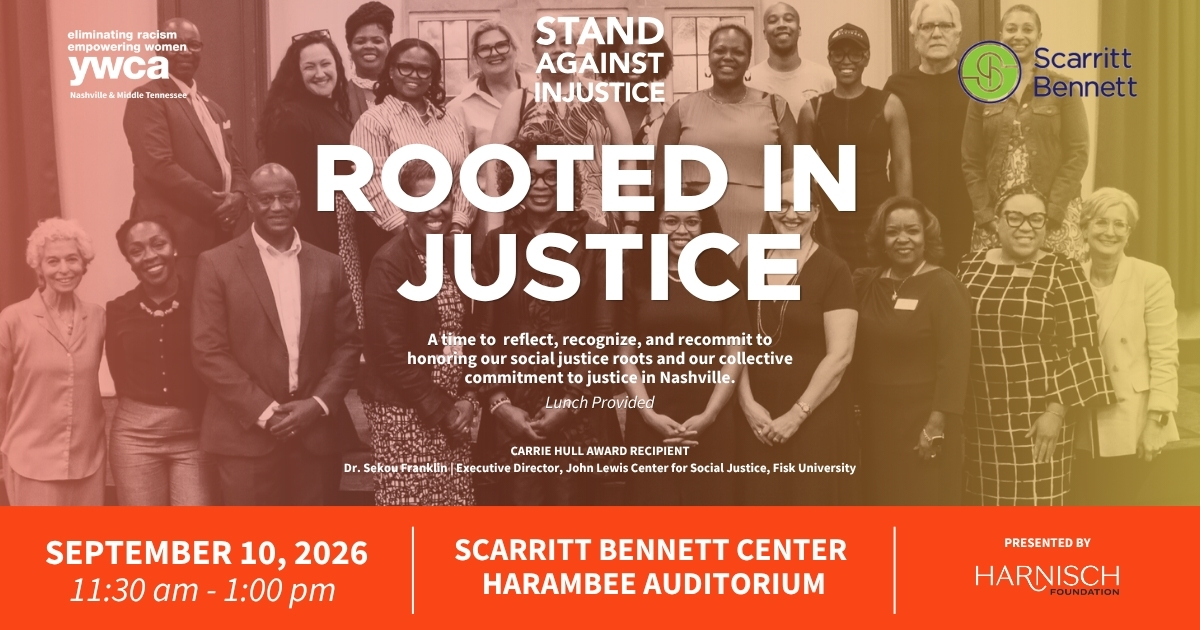
Scarritt Bennett Center and YWCA Nashville & Middle Tennessee both carry deep histories of justice, education, and community gathering in Nashville. That shared legacy is why we are coming together on Thursday, September 10th, 2026 for Stand against Injustice: Rooted in Justice. We invite you to take a stand with us.
This year’s theme “Rooted in Justice” invites us to remember the work that came before us, name the roles we each play now, and recommit ourselves to building a more just Nashville together. We will also recognize Dr. Sekou Franklin with the Carrie Hull Award for his tireless work for social justice.
Our shared history reminds us that meaningful change is never accomplished by spectators. It is carried forward by people willing to stand, speak, serve, organize, advocate, and act. We honor those who came before us not only by remembering their names, but by continuing their work.
Join us. Come prepared to listen, learn, connect, and recommit to the work of justice.
Stand Against Injustice: Rooted in Justice
Thursday, September 10
11:30 a.m.–1:00 p.m.
Scarritt Bennett Center
Harambee Auditorium
1027 18th Avenue South
Nashville, Tennessee 37212
Please RSVP through the link or on our website so that we can ensure lunch is provided for everyone who joins us.
Let’s Pray
God of justice, mercy, and liberation, thank You for the courageous people whose deep roots of faith made a way for us. Thank You for the women and men, named and unnamed, who stood against injustice, carried communities, opened doors, and planted seeds whose fruit we enjoy today.
When the storms of society rage, keep us rooted. When the branches bend, strengthen us. When familiar structures break, give us wisdom to build what is more just. Protect us from confusing religious activity with faithful action.
Give us courage to do justice when it is unpopular, compassion to love mercy when division is easier, and humility to walk with You when pride demands the spotlight. God, give us sensitive ears to hear the voices of those most affected by injustice. Restore those who are weary. Remind women who have carried so much that You desire not only their survival, but their wholeness, freedom, safety, dignity, and joy.
Make us worthy stewards of the legacy entrusted to us. May our lives become roots of righteousness upon which future generations can stand.
In Your holy and liberating name, we pray. Amen.
Standing Rooted in Justice,
Rev. Sondrea L. Tolbert
Executive Director & CEO
Scarritt Bennett Center
No Comments